
 ADMIN ST BUSINESS
Rugby positions are fundamental to understanding the sport, whether you are a player, coach, or avid fan. Each player has a distinct role on the field, contributing to the team’s overall strategy, from winning possession in scrums to scoring decisive tries. Learning rugby positions allows fans to appreciate the skill and coordination involved in rugby today, especially during high-profile events like the Rugby World Cup or the Six Nations.
Understanding rugby positions also enhances engagement with media coverage, including BBC rugby, BBC sport rugby, and other platforms reporting on rugby scores. Whether watching a local fixture, following Bath Rugby, or analysing the Rugby World Cup 2025, recognising each role on the field allows you to see how individual contributions combine to form a cohesive and successful team strategy.
Understanding Rugby Positions: Forwards and Backs
Rugby positions are divided into forwards and backs, with each group serving unique functions on the field. Forwards, typically numbered one to eight, focus on physical contests like scrums, rucks, and lineouts. They provide the power necessary to win possession and create opportunities for the backs to execute attacking plays. Mastering rugby positions means recognising these dynamics and understanding how each forward contributes to the team’s dominance.
Backs, numbered nine to fifteen, are the speedsters and tacticians of the game. Their primary responsibility is to create scoring chances, exploit gaps in defence, and execute tactical kicking. Observing rugby positions in the backs enhances your comprehension of how a team’s offensive and defensive strategies unfold. Fans of England rugby, Wales rugby, and Scotland rugby can benefit from understanding these roles to follow matches and tournaments more effectively.
Detailed Guide to Forwards
Forwards occupy the front and second rows of the scrum and are integral to controlling possession. The front row, consisting of props and a hooker, engages in intense physical battles to secure the ball. Locks provide height for lineouts and power in scrums, while flankers and the number eight offer mobility, supporting both offensive and defensive play across the field.
Rugby positions within the forwards demand a combination of strength, endurance, and tactical awareness. Players in these roles are responsible for initiating contact, maintaining ball security, and setting up attacking opportunities for the backs. Following matches involving teams like Bath Rugby or monitoring rugby league scores allows fans to see the impact of forwards and understand how their efforts translate into overall team performance.
Detailed Guide to Backs
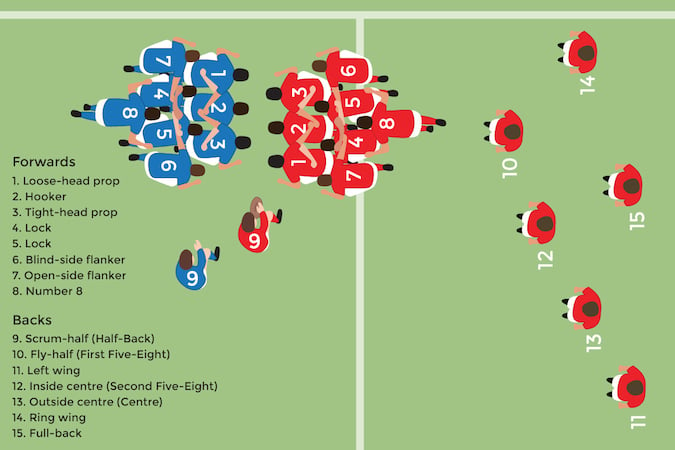
Backs in rugby positions are crucial to attacking strategies and scoring opportunities. Scrum-halves and fly-halves direct the game, linking forwards and backs while managing field position and territorial advantage. Centres break defensive lines and create gaps, wings exploit speed to finish plays, and full-backs act as the final line of defence, often initiating counter-attacks.
Understanding rugby positions in the backs is essential for appreciating tactical decision-making. During major events like the women’s rugby world cup or the Rugby World Cup 2025, these roles often determine match outcomes. Fans who understand how each back functions can follow rugby fixtures more closely and gain deeper insight into the strategic elements of rugby union gameplay.
Rugby Variations and Positional Differences
Rugby positions differ between rugby union and rugby league. Rugby union uses fifteen players per side, with specialised roles in both forwards and backs, while rugby league has thirteen players, requiring some positions to adapt or combine responsibilities. Sevens rugby further alters positions, demanding versatility and increased stamina from each player.
Recognising these differences enhances both gameplay understanding and fan experience. Observing BBC rugby league coverage, Scotland rugby, or Ireland rugby matches demonstrates how positional changes affect tactics and scoring opportunities. Fans following rugby today or analysing rugby world cup finals can appreciate how each variation influences team strategy and individual performance.
How Understanding Positions Improves Your Game and Viewing
For players, mastering rugby positions is essential to maximise potential on the field. Knowledge of positional responsibilities helps players choose roles suited to their physical attributes and skill sets, improving communication and teamwork during matches. Each rugby position contributes uniquely to creating space, maintaining possession, and executing successful attacks or defensive plays.
For fans, understanding rugby positions makes watching matches more engaging and informative. Recognising how forwards dominate possession and how backs exploit gaps enhances comprehension of commentary on BBC sport rugby or when following rugby fixtures. This knowledge enriches viewing experiences, whether attending a local game, following Bath Rugby, or watching international tournaments such as the Rugby World Cup 2025.
Conclusion
Rugby positions form the backbone of the sport, defining player roles and team dynamics. Each position, from forwards to backs, contributes to the pace, strategy, and outcome of matches. Knowledge of rugby positions allows players to excel and fans to gain a deeper appreciation of rugby union gameplay, major tournaments, and local fixtures.
Understanding rugby positions also bridges the gap between casual viewers and expert fans. Observing positional play enhances strategic awareness, from lineouts and scrums to try-scoring opportunities. Following events like women’s rugby world cup, rugby six nations, and Rugby World Cup 2025 becomes more rewarding when the significance of each rugby position is fully understood.
You may also read: Core Elements of an Effective Protocolo Operacional Padrão